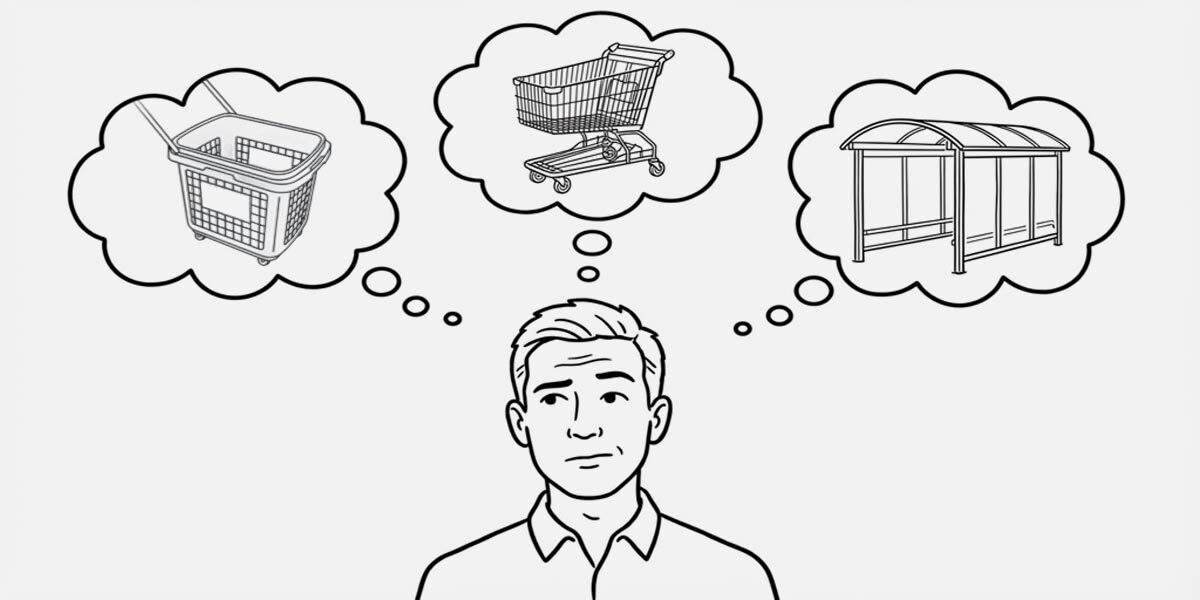
Five things to do when planning your store
Consider before purchasing Shopping Trolleys and baskets
Things to consider when buying Shopping Trolleys and baskets are a good idea. Not only does it allow the customer to move their items from the shelf to the checkout, but it can also increase your average purchase and increase customer satisfaction.
Five things to think about
We have five points for how you should think to make it as good as possible for your store.
1. condition
The shopping cart is the first thing the customer encounters in the store and the last thing she leaves behind. The impression therefore plays a big role, both in how she experiences her purchase and in the feeling she takes away from there.
Being greeted by a dirty cart with flyers, trash in the basket or wheels that are not moving properly quickly creates irritation. A clean, intact and fresh cart instead signals care and quality – and contributes to a more pleasant shopping experience.
We therefore recommend that supervision of Shopping Trolleys becomes a recurring daily routine, preferably in connection with other tasks such as marshalling.
2. number
There is a simple rule of thumb for estimating the need for Shopping Trolleys : the store's turnover multiplied by two. For example, if you have a turnover of 100 million SEK, you should have around 200 Shopping Trolleys .
The rule serves as a basis, but often needs to be adjusted. If you have shopping carts on wheels, the need for trolleys decrease by up to 10–15%. However, if the store is located in a shopping center, where customers use The trolley for a longer period of time, more are often required trolleys .
Are there more? trolleys always better? No. Too many stationary trolleys In shopping cart garages, the need for maintenance and cleaning increases, while they also collect dirt and dust.
3. size
It used to be said that bigger trolleys automatically increased the average purchase – that is only partly true. Comfort and freedom of choice are more important. Different customers have different needs.
A customer who is planning a small additional purchase and is only met with large trolleys often choose a basket instead. By offering a slightly smaller cart, for example 100–130 liters, you create a better alternative.
How many sizes should you have? We recommend two to three different cart sizes and two types of baskets – one on wheels and a traditional shopping basket.
4. location
The shopping cart is used at two crucial times: on the way into the store and on the way out.
At the entrance, the carts should be placed as close to the entrance as possible to be easily accessible. When the customer leaves the store, she in turn wants to be able to put her The trolley near the car – or in some cases near the exit.
Offering multiple parking spaces makes things easier for the customer and improves the overall experience.
5. handling
Ongoing maintenance of Shopping Trolleys is crucial. It involves both regular maintenance – washing, replacing wearing parts and repairs – and marshalling the carts to the correct parking spaces.
Well-functioning and accessible trolleys are just as important to the customer experience as well-stocked and neatly fronted shelves.
The expert's perspective
Pekka Ritari has over 40 years of experience in furnishing stores in Scandinavia.
– We are happy to help our customers think the right way. By visiting stores around the country, we get a clear picture of the conditions on site. We also notice that customer demands have changed compared to 10–15 years ago.
Today's customer expects different cart sizes depending on whether they are shopping weekly or making a small purchase. Dissatisfied customers will, in the worst case, choose to avoid your store altogether.
– We sell and maintain trolleys for all needs. Two popular options are our own Scandinavia 160L design with a lower shelf, combined with the smaller Polycart 100L. Many larger stores also choose to buy or rent electric QuicKarts for efficient stacking and to protect their staff's backs.